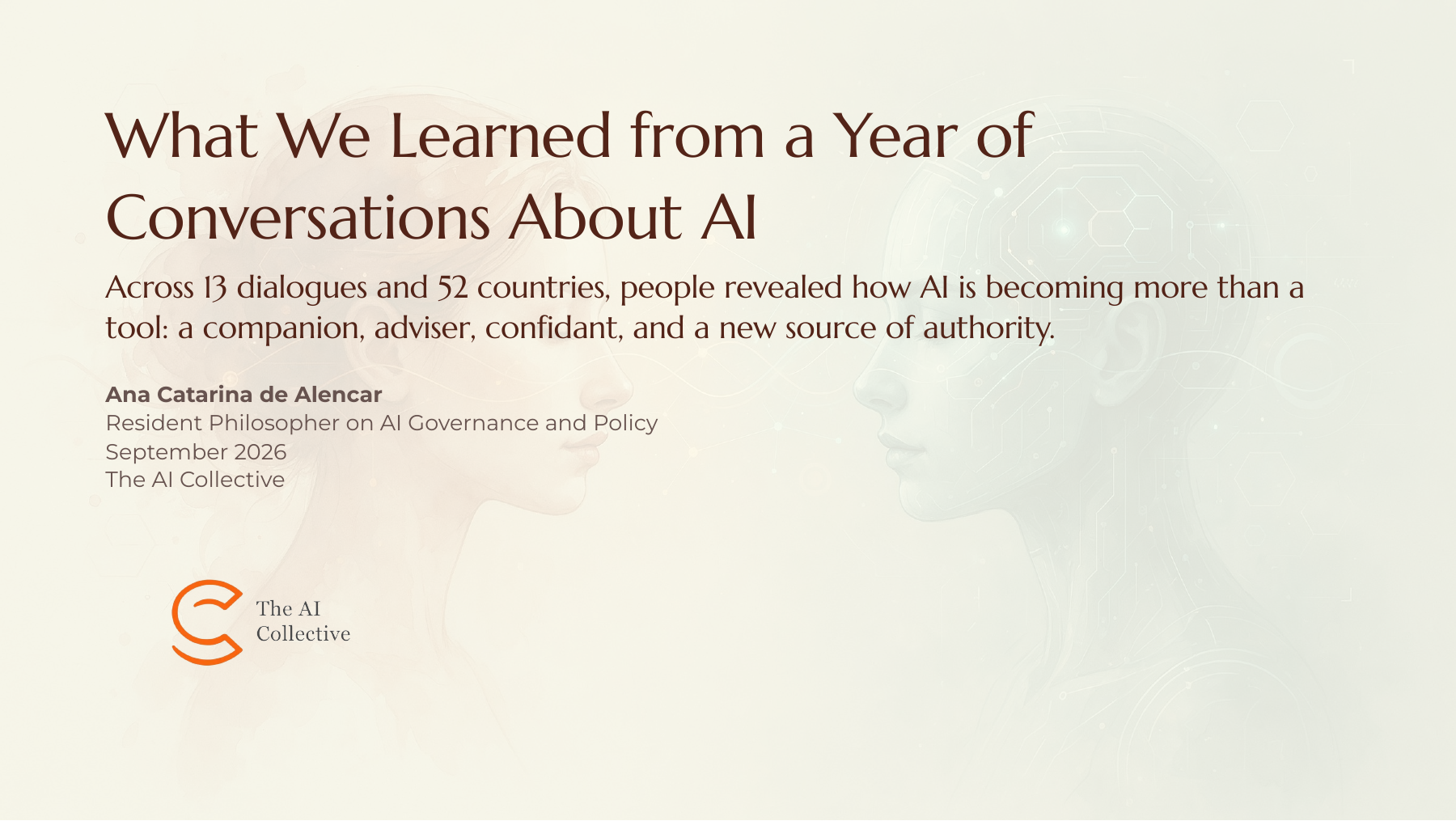
13 DIALOGUES · 52 COUNTRIES · SEPTEMBER 2026

When AI
becomes more
than a tool.

Across a year of public conversations, people revealed how AI is becoming a companion, adviser, confidant and a new source of authority. We asked what this changing relationship means for governance — and for being human.

Cover of What We Learned from a Year of Conversations About AI66 PAGES · PDF
13global public
dialogues
20+experts · 8
disciplines
937registrations
52countries · 6
continents
6governance
findings
10actionable
recommendations

AI is no longer
experienced only
as a tool.

ESTABLISHED AI GOVERNANCE

Data

Algorithm

Output

WHAT THE DIALOGUES REVEALED
RELATIONSHIPtrust · attachment · influence · continuity

Across neuroscience, law, psychology, theology, education, philosophy and product design, different voices repeatedly returned to the same invisible objects: relationships, inferences, dependencies, continuity and the architecture of interaction itself. We call the resulting framework Relational AI Governance.

Six findings.
One new object.

Patterns identified independently across disciplines — not derived from theory. Select a finding to explore its core insight and governance implication.

FINDING 01The mind

The law regulates data, but the harm lies in inference

CORE INSIGHT

The law protects categories of data. The deeper risk is what systems conclude about a person’s emotions, vulnerabilities, intentions and future behaviour — even from ordinary conversation alone.

GOVERNANCE IMPLICATION

Protect mental and neural data according to what it reveals, not where it was collected. Governance must reach the models built about a person and the actions taken from them.

The next frontier of AI governance is no longer only deciding what machines are permitted to do. It is deciding what kinds of relationships we are willing to engineer between humans and machines, and on whose terms.

— REPORT CONCLUSION

Ten recommendations.
Four communities.

01

LEGISLATORS & REGULATORS

  1. 01

    Protect mind data, including inferences wherever generated

  2. 02

    Define what manipulative AI design looks like

  3. 03

    Establish duties of relational care across the AI lifecycle

  4. 04

    Require the right human institution to remain involved

02

COMPANIES BUILDING RELATIONAL AI

  1. 05

    Measure user outcomes, not only engagement

  2. 06

    Design relationships that users can leave

  3. 07

    Make AI value formation pluralistic, transparent, reviewable and contestable

03

CIVIL SOCIETY, RESEARCHERS & FUNDERS

  1. 08

    Build the evidence that future regulation will depend on

  2. 09

    Make regulatory sandboxes genuinely multi-stakeholder

04

RELIGIOUS & COMMUNITY INSTITUTIONS

  1. 10

    Build existential and spiritual literacy for the AI age

From conversation
to governance
evidence.

The six findings are the author’s qualitative synthesis and should not be read as positions endorsed by every participant.

01Dialogue

Thirteen recorded public events across three tracks.

02Transcript & coding

Central claims, audience concerns, gaps and disagreements.

03Thematic analysis

Patterns compared across disciplines and contexts.

04Governance synthesis

Six findings translated into ten recommendations.

ACA

Ana Catarina
de Alencar

International lawyer and ethicist working at the intersection of AI governance, regulation and philosophy. As Resident Philosopher at The AI Collective, she designed and convened the thirteen-dialogue series behind this report.

Her interdisciplinary work examines how systems that infer and respond to emotional states are reshaping consent, autonomy, intimacy and human flourishing.

RESIDENT PHILOSOPHER

The AI Collective
Paris · San Francisco

Sixty-six pages.
A year of human questions.

Explore the complete evidence, speaker contributions, regulatory gaps, draft principles, recommendations and letters to future generations.

PDF · 4.8 MBDownload
the report
More Than a Tool
September 2026